LEONARDO DE ARAUJO
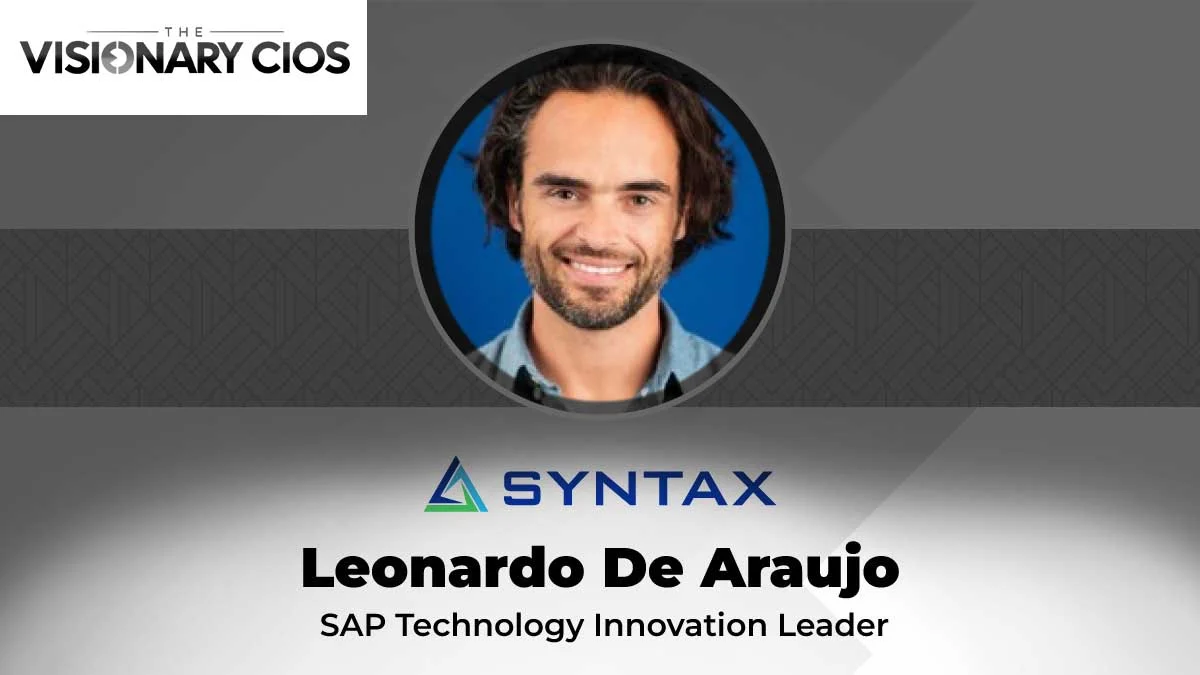
MODERNIZING THE ENTERPRISE CORE: GENERATIVE AI IN ERP ARCHITECTURE, CLEAN CORE MIGRATIONS, AND THE TRANSFORMATION OF SAP ENGINEERING
Published Exclusively by The Visionary CIOs (thevisionarycios.com)
Bureau of Enterprise Technology & Cybersecurity Architecture
EXECUTIVE EDITORIAL FOREWORD: THE RE-ENGINEERING OF THE ENTERPRISE NERVOUS SYSTEM
In the landscape of global enterprise computing, Enterprise Resource Planning (ERP) systems represent the foundational central nervous system. Across Fortune 500 manufacturing conglomerates, global retail supply chains, pharmaceutical giants, and energy titans, ERP platforms—overwhelmingly anchored by SAP—coordinate inventory movements, reconcile financial ledgers, orchestrate manufacturing lines, and process trillions of dollars in commercial transactions daily.
Yet, behind the operational stability of these mission-critical systems lies decades of accumulated technical debt: millions of lines of proprietary custom ABAP code, undocumented legacy modifications, and tightly coupled database extensions.
For the past twenty years, enterprise organizations modified their core ERP systems extensively to meet unique operational needs. However, as organizations now confront mandatory, generational migrations to SAP S/4HANA Cloud and cloud-native business architectures, that legacy customization has become an agonizing anchor. It paralyzes release velocity, introduces severe compliance vulnerabilities, and conflicts violently with SAP’s modern “Clean Core” architectural mandate.
Navigating this complex convergence between legacy ERP engineering and next-generation cloud innovation is Leonardo De Araujo, SAP Technology Innovation Leader at Syntax. With nearly three decades of dedicated leadership within the global SAP ecosystem, De Araujo stands as one of the enterprise software industry’s premier authorities on ERP modernization, solution integration, and business process optimization.
Under his strategic direction, Syntax is pioneering the practical, enterprise-grade deployment of Generative AI within complex ERP environments. Most notably, his division has introduced Syntax AI CodeGenie—a purpose-built GenAI solution designed to automatically document, interpret, and remediate legacy custom SAP code running on SAP Business Technology Platform (BTP), without exposing sensitive enterprise code to public large language models.
In this comprehensive, deep-dive executive interview with The Visionary CIOs, Leonardo De Araujo delivers an essential architectural roadmap for Chief Information Officers, Chief Technology Officers, and enterprise software leaders. He unpacks the real-world mechanics of SAP S/4HANA Clean Core migrations, deconstructs how generative AI is shifting developers from manual syntax writers into strategic solution architects, reveals how automated code documentation drives down total cost of ownership (TCO), and outlines five pragmatic ways modern software engineering teams can harness generative AI to scale enterprise performance toward the next decade.
EXECUTIVE DOSSIER & PROFILE
- Executive Name: Leonardo De Araujo
- Current Title: SAP Technology Innovation Leader
- Enterprise Organization: Syntax
- Industry Experience: Nearly 30 years of elite engineering and architectural leadership across the global SAP and ERP ecosystem
- Core Specialization: Enterprise ERP Architecture, SAP S/4HANA Cloud Migrations, Clean Core Architecture Strategy, Generative AI for Enterprise Codebases, SAP Business Technology Platform (BTP), Custom Code Remediation & Governance
- Key Innovation: Syntax AI CodeGenie — Enterprise-grade GenAI engine built natively on SAP BTP for automated custom code documentation, architectural insights, and clean-core decoupling
- Official Publication: The Visionary CIOs (thevisionarycios.com)
- Editorial Domain: Enterprise ERP Modernization, Generative AI Software Engineering, Cloud Architecture
THE COMPREHENSIVE EXECUTIVE INTERVIEW
Q1. Reflecting on your nearly three decades leading within the SAP and enterprise ERP ecosystem, how has your mandate at Syntax evolved to address today’s modern technological demands?
LEONARDO DE ARAUJO:
I have dedicated nearly thirty years of my professional life to the SAP and enterprise computing ecosystem. Throughout that journey, my core mission has been designing, engineering, and deploying large-scale Enterprise Resource Planning (ERP) solutions that enhance operational excellence, drive profitability, and unlock sustainable business value across diverse global industries.
Over the decades, I have guided multinational enterprises through every major tectonic shift in business software: from client-server architectures and early on-premises R/3 deployments to enterprise SOA, high-speed in-memory computing with SAP HANA, and now, hyperscale multi-cloud platforms.
Today at Syntax, I lead the SAP Technology Innovation division. My executive mandate is focused on defining, architecting, and executing our global technology strategy around the modern SAP ecosystem. This encompasses deep solution integration, business process optimization, hybrid cloud architectures, and fundamentally, the practical, disciplined adoption of next-generation technologies—most notably Generative AI.
What distinguishes our operational philosophy at Syntax is a relentless commitment to pragmatic innovation.
In the enterprise software market, it is remarkably easy to get swept away by speculative technology hype and flashy vendor demonstrations that fail under production conditions. Our objective is fundamentally different: we engineer and deliver solutions that are not merely intelligent and innovative on paper, but tailored, secure, cost-effective, and battle-tested to address the complex, messy realities our clients navigate on the enterprise ground floor.
Q2. Unpack the architecture and strategic value behind Syntax’s new AI CodeGenie. How does it solve the chronic crisis of legacy custom code for enterprises migrating to SAP S/4HANA?
LEONARDO DE ARAUJO:
Syntax AI CodeGenie is our flagship innovation engineered specifically to solve one of the most acute, expensive, and protracted pain points in enterprise software: the chaotic reality of legacy custom code.
Over the past twenty-five years, enterprises running on-premises SAP ECC environments developed tens of thousands of custom ABAP objects, user exits, bespoke reports, and proprietary database modifications. In many organizations, the original developers who authored that code retired or departed a decade ago. The documentation is either non-existent, hopelessly outdated, or buried in fragmented spreadsheets.
When organizations prepare for their mission-critical migration to SAP S/4HANA Cloud, this undocumented custom code becomes a multi-million-dollar roadblock. It paralyzes migration timelines, introduces severe operational risk, and conflicts violently with SAP’s architectural “Clean Core” strategy.
Syntax AI CodeGenie is a Generative AI-powered solution built natively to demystify and automate the governance of this custom code landscape.
Architectural Highlights:
- Automated AI-Powered Documentation:
Syntax AI CodeGenie uses specialized large language models to inspect, parse, and analyze proprietary custom ABAP code, automatically generating comprehensive, structured, and consistent technical documentation down to the method, table, and interface level. - Enterprise-Grade Security & Model Sovereignty:
In enterprise ERP, your custom code is your competitive advantage; it embodies your proprietary business algorithms and pricing logic. AI CodeGenie guarantees absolute data sovereignty: zero customer code is ever transmitted to external public LLMs, and no customer data is ever utilized to train third-party public models. It is fully isolated, cryptographically secured, and governed within the client’s enterprise perimeter. - Contextual Natural-Language Chatbot Interface:
Rather than forcing an architect to manually read thousands of lines of legacy code to understand a pricing calculation, developers and business analysts can query the codebase in natural language: “How does our legacy billing routine handle tax exemptions in EMEA?” The AI analyzes the code graph and provides immediate, contextual, and mathematically accurate explanations. - Frictionless Multi-System Deployment on SAP BTP:
AI CodeGenie is engineered to run seamlessly on the SAP Business Technology Platform (BTP). It supports heterogeneous SAP environments, including legacy on-premises SAP ECC, SAP S/4HANA On-Premises, and SAP S/4HANA Cloud Private Edition, allowing organizations to modernize at their own cadence.
Key Commercial & Technical Benefits:
- Dramatic Operational Risk Reduction: Accurate, automated documentation eliminates single-person dependencies and ensures audit and compliance readiness.
- Multiplied Developer Productivity: Engineering teams are liberated from hundreds of hours of manual reverse-engineering drudgery, shifting their intellect to high-leverage innovation.
- Substantial Reduction in Total Cost of Ownership (TCO): By automating up to 80% of legacy code evaluation and documentation overhead, enterprises save millions in external systems integrator consulting fees.
- Accelerated Architectural Decision-Making: Executive stakeholders gain immediate clarity on which custom code objects can be deprecated, which can be adapted, and which can be cleanly decoupled onto SAP BTP.
Q3. Why are enterprise organizations increasingly turning toward AI-powered code generators and automated documentation, and how is this fundamentally transforming the developer’s role?
LEONARDO DE ARAUJO:
Enterprise leadership is finally confronting the profound economic inefficiency of manual custom code management.
In traditional software operations, manual code documentation is universally despised by engineers, notoriously error-prone, and outdated the second a developer makes a commit. In a large enterprise with millions of lines of code, maintaining human documentation across decades is mathematically impossible.
This operational bottleneck becomes an existential crisis during major digital transformations—specifically the migration to SAP S/4HANA Cloud.
To achieve the scalability, automated patching, and continuous innovation of cloud ERP, enterprises must adhere strictly to SAP’s “Clean Core” paradigm. Clean Core dictates that the ERP core must remain pristine and standard: all custom logic, third-party integrations, and extensions must be decoupled and built outside the core on platforms like SAP BTP, interacting strictly via standard APIs.
You cannot execute a Clean Core migration if you do not understand what your legacy custom code is doing!
AI platforms like Syntax AI CodeGenie are experiencing explosive adoption because they directly dismantle this bottleneck. They close institutional knowledge gaps, auto-generate architectural dependency graphs, and provide engineering teams with a clear roadmap of how to untangle legacy modifications.
Consequently, the role of the enterprise software developer is undergoing a profound and permanent evolution.
The era of the developer functioning as a mechanical typist—spending 60% of their day manually writing boilerplate code, looking up syntax, or drafting documentation—is over. Developers are evolving into strategic solution architects, system curators, and innovation orchestrators.
Their primary craft is no longer typing syntax; their craft is guiding intelligent AI engines, interrogating business requirements, designing modular cloud architectures, and validating security guardrails. In this new paradigm, an engineer’s competitive differentiator is their mastery of collaborating with AI platforms to deliver transformative business value at speed.
Q4. As artificial intelligence becomes ubiquitous across enterprise development pipelines, what strategic advice and best practices would you offer modern developers and IT architects?
LEONARDO DE ARAUJO:
Enterprise developers must recognize that client and business expectations have permanently shifted.
What used to be a routine business request—such as building a standard inventory report or creating an invoicing workflow—now arrives with the executive assumption that it will feature embedded artificial intelligence, predictive anomaly detection, and automated insights. Developing software without considering AI enablement is already obsolete.
To navigate this landscape and build enduring careers, modern developers must focus relentlessly on two strategic imperatives:
First, Continuous, Disciplined Upskilling at the Convergence of AI and ERP:
Do not treat artificial intelligence as a foreign discipline reserved exclusively for data scientists with Ph.D.s. Generative AI has become an intrinsic capability of modern enterprise software engineering. Developers must immerse themselves in understanding how large language models, retrieval-augmented generation (RAG) pipelines, and autonomous agent frameworks integrate into enterprise platforms like SAP S/4HANA and SAP BTP. Understand how to interact with models programmatically, how to handle vector embeddings of enterprise metadata, and how to govern API trust boundaries.
Second, Ruthlessly Augment Every Daily Workflow:
Stop writing boilerplate logic manually. Developers should aggressively integrate vetted AI assistants, coding copilots, and platforms like Syntax AI CodeGenie into their daily development routines. Use AI to brainstorm solution patterns, analyze complex data schemas, and stress-test edge cases.
By offloading repetitive cognitive tasks to AI, developers create the mental space required to take on higher-level architectural responsibilities: mastering enterprise business processes, designing decoupled clean-core extensions, and aligning technology directly with corporate profitability.
Q5. What are five concrete, high-impact ways enterprise developers and engineering leaders can harness Generative AI to scale their output and architectural quality today?
LEONARDO DE ARAUJO:
Modern engineering squads can immediately drive immense leverage by operationalizing Generative AI across five distinct software lifecycle stages:
- Accelerate Conceptual Solution Design:
Rather than starting from a blank whiteboard, developers can leverage Generative AI as an architectural sounding board. By feeding the AI high-level business requirements and constraint boundaries, engineers can rapidly explore alternative design patterns, evaluate architectural trade-offs, and map out microservice integration topologies in minutes. - Automate Repetitive Code Generation:
Leveraging specialized enterprise code generators—such as SAP Joule or proprietary domain-trained generators—reduces routine coding effort by 30% to 50%. Generating standard ABAP RESTful Application Programming (RAP) models, data definitions (CDS views), and boilerplate API wrappers can be executed near-instantaneously, allowing engineers to focus on nuanced business logic. - Automated Real-Time Code Review & Architectural Validation:
Deploying AI as a continuous peer reviewer inside developer pull requests allows organizations to catch logic flaws, performance bottlenecks, and non-compliant syntax before code is merged. The AI can evaluate whether an ABAP routine violates clean-core standards, relies on deprecated database tables, or introduces security vulnerabilities. - Maximize Automated Testing Coverage & Synthetic Data Generation:
Testing enterprise ERP systems is notoriously complex due to vast data interdependencies. AI engines can analyze application flows, identify un-tested execution branches, automatically generate comprehensive unit and integration test cases, and synthesize realistic, anonymized test data that mimics production conditions without exposing sensitive customer records. - End-to-End Automated Technical & Process Documentation:
By implementing solutions like Syntax AI CodeGenie, organizations eliminate the documentation deficit forever. AI continuously documents custom code, explains data structures, and updates functional specifications in real time as code evolves—ensuring complete transparency and audit readiness across the entire enterprise software lifecycle.
Q6. Looking toward the horizon, what upcoming enterprise capabilities, platform investments, and innovations can technology leaders anticipate from Syntax?
LEONARDO DE ARAUJO:
At Syntax, our engineering and innovation roadmap is driven directly by the evolving, mission-critical challenges facing global enterprises.
As we look toward 2026 and beyond, we are making substantial capital and R&D investments across three transformative operational pillars:
First, Radically Accelerating Implementation and Migration Timelines:
We are engineering next-generation automation frameworks and AI-augmented migration toolsets that dramatically compress project delivery schedules. Our objective is to take complex, multi-year SAP S/4HANA migrations and accelerate them by 30% to 40%, slashing operational disruption and delivering rapid time-to-value for enterprise stakeholders.
Second, Expanding Intelligent Documentation Beyond Code to Complete Project Lifecycle Governance:
While Syntax AI CodeGenie has solved the custom code documentation crisis, enterprise complexity extends across functional specifications, business process blueprints, interface configurations, and test logs. We are expanding our generative AI intelligence engines to ingest and synchronize complete end-to-end project documentation, creating a unified, natural-language knowledge graph of the entire enterprise software landscape.
Third, Pioneering Frictionless, Automated Clean Core Decoupling:
Moving to a clean core is the ultimate strategic mandate for cloud ERP survival. We are developing proprietary tooling that does not merely identify custom code debt, but actively assists engineering teams in refactoring, extracting, and re-platforming legacy modifications out of the core and onto modern, cloud-native SAP BTP extensions.
We are entering the most exciting era in enterprise computing history. At Syntax, we remain fiercely committed to empowering global enterprises with the architectures, intelligence, and execution capabilities needed to lead and thrive in an AI-driven world.