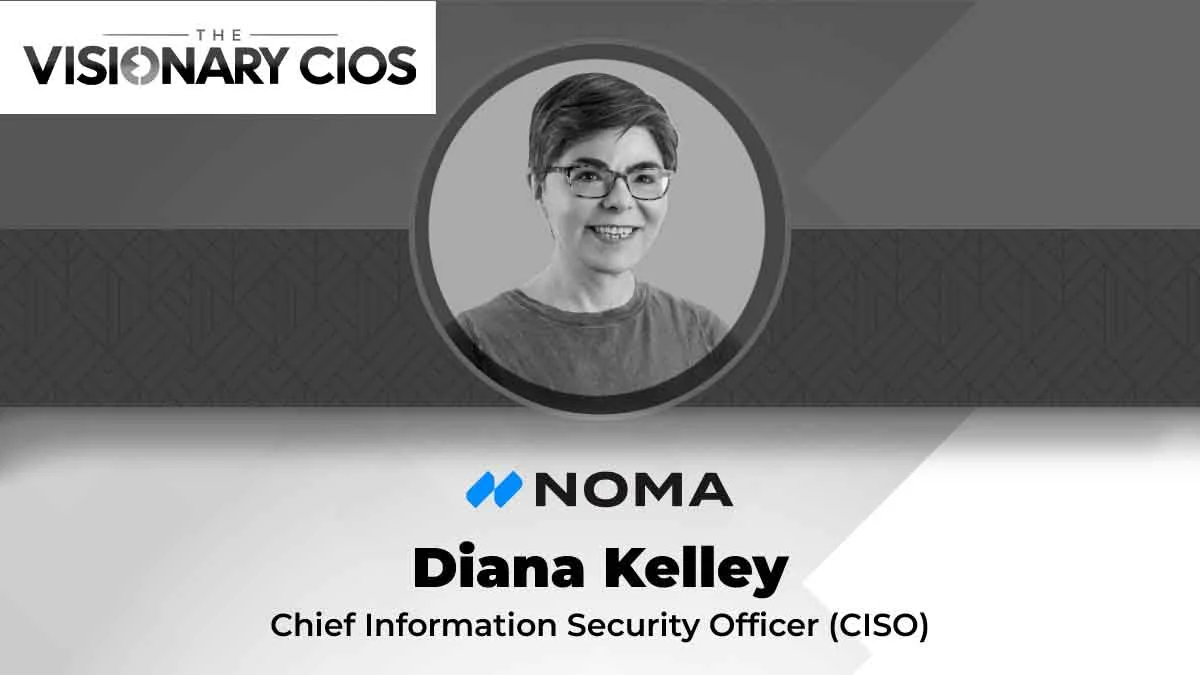
DIANA KELLEY
BEYOND THE SSO TAX & SHADOW AI: GOVERNING SAAS INTERDEPENDENCIES, AI-AUGMENTED SOC ARCHITECTURE, AND SYSTEMS-THINKING DEFENSE
Published Exclusively by The Visionary CIOs (thevisionarycios.com)
Bureau of Enterprise Technology & Cybersecurity Architecture
EXECUTIVE EDITORIAL FOREWORD: THE HYPER-CONNECTED SAAS PERIMETER
In the contemporary cloud-first enterprise, the boundary between internal infrastructure and external SaaS dependencies has permanently dissolved. An average Global 2000 organization does not merely deploy software; it is woven into an intricate, distributed web of hundreds—often thousands—of discrete third-party software-as-a-service applications, cloud platforms, and automated workflow integrations. Every single one of these connections, from Slack bots and CRM connectors to cloud analytics data pipelines, represents an active, persistent API trust relationship.
Yet, as enterprises accelerate their digital velocity, this hyper-connected ecosystem introduces severe structural vulnerabilities.
Organizations confront the predatory economics of the “SSO Tax,” where vendors paywall foundational single sign-on security behind exorbitant enterprise pricing tiers. They suffer from SaaS “Hotel California” lock-in, where data extraction and exit plans are neglected until an acrimonious vendor separation exposes proprietary data formats and orphaned service accounts.
Compounding these challenges is the unchecked explosion of enterprise artificial intelligence: employees plugging proprietary code and confidential customer data into unvetted generative models, threat actors weaponizing synthetic media and autonomous phishing swarms at unprecedented scale, and Security Operations Centers (SOCs) drowning under alert fatigue.
Standing as one of the enterprise cybersecurity community’s most articulate, experienced, and universally respected executive voices is Diana Kelley, Chief Information Security Officer at Noma Security. With a storied career spanning senior cybersecurity leadership roles at Microsoft (as Global Cybersecurity Field CTO), IBM, Symantec, Gartner, and consulting Fortune 500 boardrooms worldwide, Kelley possesses a comprehensive, three-dimensional understanding of enterprise risk. She has spent decades dissecting the delicate convergence of technical controls, corporate culture, regulatory scrutiny, and human psychology.
In this expansive, master-level executive interview with The Visionary CIOs, Diana Kelley provides an essential strategic playbook for modern Chief Information Officers and CISOs. She exposes the hidden dangers of unchecked API integrations, unpacks how the CISO role is bifurcating across global organizations, deconstructs the three-front AI crisis confronting modern security teams, highlights why prompt engineering and human empathy are the most critical underrated security controls, and outlines five urgent, non-negotiable imperatives for technology leaders governing SaaS and AI supply chains.
EXECUTIVE DOSSIER & PROFILE
- Executive Name: Diana Kelley
- Current Title: Chief Information Security Officer (CISO)
- Enterprise Organization: Noma Security
- Previous Executive Pedigree: Global Cybersecurity Field CTO at Microsoft, Cybersecurity Strategist at IBM, VP at SecurityCurve, Senior Analyst at Gartner
- Core Specialization: SaaS Security Posture Management (SSPM), AI Risk Governance & Trust, Enterprise Threat Intelligence, SOC Optimization, Systems-Thinking Defense, DevSecOps Culture
- Strategic Mandate: Leading global cybersecurity, risk governance, and compliance strategy at Noma Security, pioneering application and AI lifecycle protection for hyperscale cloud environments
- Official Publication: The Visionary CIOs (thevisionarycios.com)
- Editorial Domain: Enterprise SaaS Governance, AI Security Architecture, Executive Cyber Leadership
THE COMPREHENSIVE EXECUTIVE INTERVIEW
Q1. From your decades of frontline cybersecurity leadership across SaaS and cloud giants, what are the most urgent, top-of-mind SaaS security realities that enterprise CISOs must address today?
DIANA KELLEY:
When I analyze the current enterprise SaaS landscape, four critical, interconnected friction points immediately rise to the surface:
First is the Egregious Reality of the “SSO Tax”:
Enterprises are onboarding new SaaS tools at breakneck speed. A business unit finds a brilliant productivity tool, signs up for an initial team plan that looks incredibly cost-effective on a corporate credit card, and begins processing business data. Then, the CISO’s office steps in and mandates that the tool must be integrated with corporate Single Sign-On (SSO) and Multi-Factor Authentication (MFA) to enforce centralized identity governance, session revocation, and conditional access.
Suddenly, the vendor demands a 200% to 400% price hike to upgrade to their “Enterprise Tier” simply to unlock SAML or OIDC SSO!
This predatory pricing practice—tracked extensively by the community at ssotax.org—is a non-trivial budgetary burden. It creates immense friction between the CISO and the C-suite, because non-technical executives often mistake a basic “Login with Google” or “Login with Microsoft” social auth button for true enterprise identity federation. Explaining that true SSO is a foundational security control, not a luxury feature, is an ongoing executive challenge.
Second is the Power of Real-Time, Continuous Compliance & Trust Portals:
For years, the industry’s third-party risk management (TPRM) standard was requesting a vendor’s static, once-a-year SOC 2 Type 2 report. That is no longer sufficient. Static PDF audits tell you how a vendor operated six months ago; they tell you nothing about their security posture today.
Leading SaaS organizations are replacing this ritual by standing up public, dynamic “Trust Centers.” Being able to navigate to a vendor’s live Trust Portal to see active continuous compliance monitoring, real-time control testing, system uptime, and an exhaustive, transparent list of their 3rd-party and 4th-party data sub-processors is transformative for vendor risk management.
Third is the “Hotel California” Syndrome of SaaS Exit Plans:
Many enterprise teams treat SaaS procurement like The Eagles’ famous Hotel California: you can check in anytime you like, but you can never leave. Organizations spend months negotiating onboarding terms, but almost nobody rigorously tests their exit strategy.
When an enterprise inevitably decides to replace a vendor due to cost, performance, or strategic pivots, they suddenly discover a nightmare: their proprietary customer data is locked in an esoteric, unexported format, API rate limits throttle bulk egress, contract termination clauses trigger massive penalties, and thousands of stale service accounts and OAuth tokens remain active. You must test your SaaS exit plan, data extraction protocols, and credential cleanup before you sign the contract, not when you are trying to walk out the door.
Fourth is the Creeping Threat of Unreviewed SaaS Integrations:
Every modern SaaS platform wants to plug directly into your corporate Slack, your Salesforce CRM, your Google Workspace, and your AWS cloud storage. Each of these connections is not a casual link; it is an active, programmatic API trust relationship.
Left unchecked, these integrations become stealthy, lethal attack paths. A forgotten “read/write” OAuth permission granted to a marketing widget two years ago can easily become the open side door an adversary exploits to achieve lateral movement and exfiltrate customer databases. Conducting mandatory, quarterly SaaS integration audits is one of the simplest, highest-ROI security hygiene controls an enterprise can establish.
Q2. Where do you see the CISO role evolving amidst the current explosion of artificial intelligence, cloud automation, and product innovation?
DIANA KELLEY:
The CISO role has never been more vital, more visible, or more scrutinized. In the modern global enterprise, we are responsible for information security—and in today’s economy, there is virtually nothing in the business that isn’t connected to the cloud! Even physical security is fundamentally online: digital badge logs, biometric access systems, and security camera telemetry are ingested into cloud repositories.
What is fascinating to observe across the global market is how radically different organizations are drawing the organizational boundaries around the CISO’s office. We are seeing a distinct structural bifurcation into two distinct models:
Model A: The Strategic Advisor & Risk Orchestrator
In this archetype, enterprise leadership carves away almost all operational machinery—except the Security Operations Center (SOC), incident response, and active threat hunting—from the CISO’s direct management. Compliance and audit are handed to Legal and GRC; physical security goes to Facilities; Identity and Access Management (IAM) is embedded within Core IT; security awareness training shifts to Human Resources; and vendor risk management goes to Procurement.
In this structure, the CISO operates as an executive strategist, board advisor, and risk translator. Their focus is high-level business alignment, geopolitical threat interpretation, capital allocation, and executive communication.
Model B: The Chief Operating Officer of Enterprise Security
In this model, the organizational pendulum swings to the opposite extreme. The enterprise consolidates every conceivable security domain directly under the CISO’s command: product security, cloud infrastructure defense, IAM, physical security, corporate compliance, vendor risk, privacy, and threat intelligence. In these organizations, the CISO operates essentially as an executive Chief Operating Officer for security, directly owning every single defensive control surface across the enterprise.
Neither model is inherently “right” or “wrong.” They reflect an organization’s unique culture, regulatory complexity, industry vertical, and appetite for risk.
Looking ahead, as security platforms become deeply AI-augmented, CISOs will not be expected to micromanage low-level operational workflows because automated agents and distributed engineering teams will handle the routine heavy lifting. However, the CISO will face an entirely new executive mandate: governing AI risk, verifying that internal defensive models are cryptographically trustworthy, and preparing the enterprise for sophisticated adversaries wielding autonomous artificial intelligence at scale.
Q3. What represents the primary operational crisis keeping cybersecurity teams awake at night in today’s threat landscape?
DIANA KELLEY:
The defining crisis keeping CISOs and engineering teams awake at night is the chaotic, unmanaged adoption of artificial intelligence across three distinct battlefronts:
- The Crisis of AI Governance and Shadow IT:
Artificial intelligence has become the ultimate incarnation of Shadow IT. Enthusiastic employees across every department are plugging generative models into their daily workflows without IT approval. Simultaneously, commercial enterprise software vendors are embedding proprietary AI models and LLM features into existing products without transparent disclosure. Data flows have become opaque.
What terrifies CISOs is the acute realization that confidential customer intellectual property, proprietary financial spreadsheets, protected healthcare information (PHI), or proprietary source code may already be traversing unvetted, external AI models. True governance requires an exhaustive, continuous AI asset inventory: knowing what models exist, where they are hosted, who has access, what data they consume, and what actions they can trigger. Without that baseline inventory, any risk report presented to the board of directors is dangerously incomplete.
- The Challenge of Operationalizing AI Effectively in the SOC:
Security Operations Centers are under immense structural strain: chronic alert fatigue, crippling talent shortages, and massively expanding attack surfaces. AI promises faster telemetry correlation, automated triage, and intelligent incident response.
However, the operational friction lies in training analysts to collaborate with AI rather than simply treating it as a shiny, bolted-on novelty. Security teams are wrestling with profound questions: How do we mathematically validate AI-generated detections? How do we fine-tune prompts to suppress false positives without blinding the SOC to zero-day anomalies? And how do we ensure an AI model’s incident recommendations are auditable and explainable to regulatory bodies? Teams are caught between the fear of missing out on AI’s speed and the terrifying risk of relying on hallucinations.
- Defending Against Adversaries Wielding AI as a Force Multiplier:
We have entered the era of industrialized, autonomous cyber offense. Threat actors are utilizing generative AI to craft phishing lures in flawless, idiomatic local dialects. Social engineering personas are synthesized and adapted in real time. Adversarial models can write polymorphic malware, test it against public defensive tools, and optimize it to bypass EDR agents.
This shifts the entire scale of enterprise defense: instead of an attacker firing off a thousand sloppy, generic emails, an enterprise faces a million bespoke, hyper-targeted attack vectors simultaneously. CISOs are forced to ask: Is our SOC equipped to detect synthetic identities and executive deepfakes? Can our data loss prevention (DLP) controls prevent prompt injection attacks against our public-facing AI agents? Defending against this scale requires completely rethinking defensive operations.
Q4. What are the most underrated, overlooked skills within modern cybersecurity and data protection teams that require immediate investment?
DIANA KELLEY:
There are three critical capabilities that are tragically undervalued in modern cybersecurity engineering:
- Advanced AI Prompt Engineering for Security Operations:
Right now, prompt engineering in cybersecurity feels identical to the early days of writing custom Snort IDS or SIEM correlation rules: the rare practitioners who understand how to do it well quietly wield extraordinary leverage, while everyone else wonders why their automations break.
Prompt engineering is not about typing casual questions into a chat window. In a security context, it is a rigorous technical discipline: structuring inputs, setting strict deterministic boundaries, anchoring models with contextual metadata, and preventing prompt leakage. A skilled security prompt engineer can instruct an LLM to parse fifty thousand lines of raw firewall and cloud logs and instantly extract the three anomalous command-and-control beacons that actually matter, saving hours of manual analyst pivoting.
- Empathy as an Architectural Security Control:
Technical leaders often dismiss empathy as a “soft” interpersonal skill, but in practice, empathy is a hard-edged, vital security control. The most effective security professionals do not view themselves as corporate police officers whose job is to bludgeon employees with policy documents.
They possess the empathy to step directly into the shoes of a software developer racing against a high-stakes release deadline, or a customer success representative trying to prevent a client churn. When you understand their operational pressures, you stop designing security controls that create friction, and you start engineering frictionless paths that allow employees to achieve their business goals while remaining completely secure. Empathy eliminates the incentive for employees to invent insecure workarounds.
- Deep Systems Thinking:
Major cybersecurity catastrophes almost never occur because a single security tool failed. Catastrophes occur because of a cascade of small, seemingly insignificant cracks aligning across the enterprise architecture.
Systems thinking is the intellectual discipline of seeing the holistic web of interdependencies connecting SaaS providers, API data flows, identity boundaries, cloud infrastructure, and human behavior. It is about understanding how an obscure permissions change in one SaaS platform ripples across the entire network. Systems thinking shifts security from chasing symptoms—patching malware on an endpoint—to solving root causes: realizing that the incident was enabled by an overly permissive OAuth integration, lax IAM role governance, and a rushed employee onboarding process.
Q5. In closing, what are the five foundational directives you would leave with every SaaS CIO, CTO, and CISO navigating enterprise leadership today?
DIANA KELLEY:
I would leave technology and security executives with five pragmatic, non-negotiable mandates:
- Establish an Immutable AI Asset Inventory Immediately:
You cannot secure, govern, or audit what you do not know exists. Treat AI with the same discipline applied to cloud infrastructure. Build a centralized, continuously updated AI asset inventory that catalogs every internal model, vendor AI feature, autonomous agent, and data integration across your enterprise. Make this inventory a standing, audited report in every quarterly board risk review. - Stand Up an Institutional Trust Center Proactively:
Do not wait for a prospective enterprise customer, auditor, or regulator to ask why your organization lacks transparency. Build a public, dynamic Trust Portal that hosts your current SOC 2 Type 2 reports, ISO certifications, real-time control monitoring, security status updates, and a transparent directory of all 3rd-party and 4th-party data sub-processors. Transparency accelerates enterprise sales cycles and builds unassailable market trust. - Execute an Uncompromising SSO Gap Analysis Across Your Entire SaaS Stack:
Do not allow vendors to compromise your enterprise security posture through the SSO Tax. Conduct an immediate, exhaustive audit across every SaaS tool utilized by your business units. Identify where business data lives behind basic username-and-password credentials, prioritize critical platforms, and enforce centralized SAML/OIDC SSO with phishing-resistant MFA without exception. - Tabletop a SaaS Supply Chain Compromise Scenario:
Most enterprise disaster recovery and incident response playbooks still prepare for traditional on-premises ransomware. Update your reality. Run an executive tabletop simulation based on a third-party SaaS provider or critical API vendor being breached. Test your ability to instantly revoke OAuth tokens, rotate shared API keys, isolate compromised data pipelines, and execute transparent, legally compliant customer notifications under pressure. - Reassess and Map Your Data Residency and Sovereignty Commitments:
Global geopolitical tensions and privacy regulations (GDPR, CCPA, CPRA, sovereign AI mandates) are intensifying. If an enterprise customer asks your sales team, “Precisely where is my customer data stored, processed, backed up, and traversed by your AI models?”, and your engineering organization cannot answer with absolute precision, you will lose multi-million-dollar deals. Collaborate with legal, compliance, and engineering to build an accurate data sovereignty map and verify that your underlying cloud and SaaS providers can legally validate those commitments.